


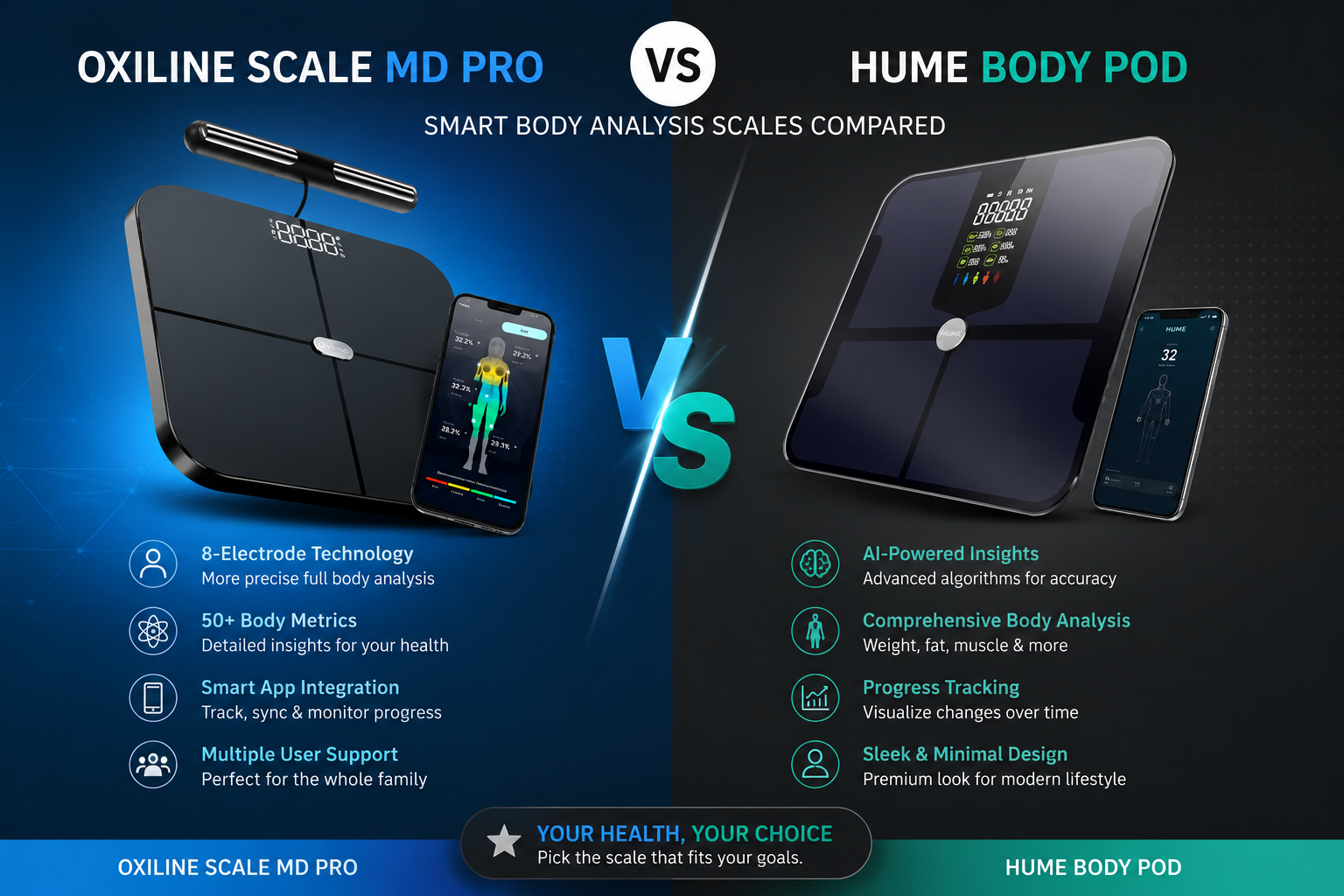
Oxiline Scale MD Pro vs Hume Body Pod: Which Body Composition Device Is Better?
Smart scales are getting smarter every day. They don't just show your weight anymore; they can tell you a lot about your body. In this comparison, I'll look at two popular options, Oxiline Scale MD Pro and Hume Body Pod, and explain how each one can help you stay on track with your health goals.
The Oxiline Scale MD Pro is simple and easy to use. It gives you basic body stats along with helpful tips based on your results. The Hume Body Pod, on the other hand, uses a method called bioimpedance to give more detailed and accurate readings about your body composition, like fat, muscle, and water levels.
Both devices have a handle-and-platform design with electrodes that you hold while standing on the scale. They both claim to be nearly as accurate as clinical scales and cost quite a bit more than a basic scale. So, which one should you really have in your bathroom? We looked into the official specifications, pricing, warranties, and independent reviews of both to help you make your choice.
Quick Comparison:
Oxiline Scale MD Pro:
Features Oxiline Scale MD Pro
List price $399
Typical sale price $170–$200
Metrics tracked 31
Sensors 8 electrodes (hands + feet)
Segmental analysis Core, arms, legs
Display 3-inch color OLED (on handle)
Connectivity Bluetooth only
App cost Free, no subscription
Battery 1 month per charge
Weight capacity 396 lbs
Multi-user support Yes (auto-recognition)
Warranty Lifetime
Return window 30 days
HSA/FSA eligible Yes
Hume Body Pod:
Features Hume Body Pod
List price $352
Typical sale price $200–$229
Metrics tracked 45
Sensors 8 electrodes (hands + feet)
Segmental analysis Core, arms, legs + water balance per limb
Display 2.8-inch display
Connectivity Bluetooth only
App cost Free tier + optional $9.99/month premium
Battery Up to 1 year per charge (manufacturer claim)
Weight capacity 400 lbs
Multi-user support Yes, up to 24 profiles
Warranty 1 year (10-year add-on available for ~$46)
Return window 45 days
HSA/FSA eligible Yes
Oxiline Scale MD Pro: Overview
The Scale MD Pro is Oxiline's Premium smart body composition scale designed to provide detailed health insights. It features the brand's Echo MD Technology, which uses 8 built-in electrodes placed in the scale, using dual-frequency bioelectrical impedance analysis (BIA). It measures key body metrics such as muscle mass, body fat, bone density, and more, giving users a complete picture of their overall health.
Standout features include:
- 31 tracked metrics, including body fat, visceral and subcutaneous fat, muscle mass, bone mass, protein levels, water weight, BMR, WHR, and body age
- Segmental breakdown for core, arms, and legs separately
- A 3-inch color OLED display built into the handle for instant readings
- A free companion app with unlimited history, PDF/CSV export, and syncing to Apple Health and Google Health Connect
- A rechargeable battery (USB-C) good for roughly a month between charges
- A lifetime warranty and 30-day money-back guarantee
Hume Body Pod: Overview
The Hume Body Pod, which is also known as "the Hume Pod," uses a similar hardware solution as 8-electrode hand-and-platform BIA technology but moves further to integrate the idea of an "AI health coach." Hume's positioning is more on insights generated by the scale than on the scale itself.
Standout features include:
- 45 monitored metrics, including the standard body fat and muscle measurements along with extra data on intercellular water distribution by limb and an indication of heart health
- The analysis includes segmental measurement for the trunk, arms, and legs
- 24 user profiles included to accommodate large families or small medical practices
- There is also an app option starting from free use and up to a $9.99 monthly "Hume+" premium subscription that comes with weekly results and personalized training via AI coaching
- A standard 1-year warranty, which can be extended up to 10 years for an extra fee
- 45-day return period
Hume focuses more on the "continuous coaching" feature compared to Oxiline, which could be appealing if you prefer the device to guide your actions; however, opting for the full experience comes with a continuous cost.
Head-to-Head Breakdown
Price and Ongoing Costs:
The device's listed price seems more budget-friendly with Hume ($352 compared to Oxiline's $399), but the real difference lies in the ongoing maintenance costs: Oxiline's app is entirely free and can be used without a subscription, whereas Hume's app has paid components, as the primary features of the product weekly health reports, AI coaching, and nutritional tracking can only be accessed by paying $9.99 monthly for a subscription to these services. Over two years, that totals an additional $240 on top of the initial hardware cost. Without the coaching aspect, Oxiline is much more economical.
Metrics and Technology:
They both use the same principle: 8 electrodes, BIA through hands and feet. Yet, Hume captures more parameters, 45 compared to 31. It goes further by providing segmental readings, including a score for the water balance in each limb and a heart condition indicator that Oxiline lacks. In terms of the number and level of detail in the metrics, Hume wins. However, the quality may not be better because most people will only care about their fat mass and muscle readings.
App Experience and Subscription Model:
This difference is more pronounced than any other when it comes to the philosophical contrasts between the two. With Oxiline, you receive a complimentary app that includes all features, such as trend charts, historical logs, multi-user access, and data exports, with no features hidden behind a paywall. Conversely, while Hume provides a free tier, access to the coaching AI, weekly reports, and nutritional tracking functionalities is limited to Hume+.
Accuracy: Marketing Claims vs. Independent Reviews
And here's where many comparison pieces fall short. While each brand markets the accuracy of its device on its website, independent testing reveals some messy issues with each piece of equipment.
Oxiline does not specify a precise accuracy rate for its DEXA-technology scale on its own site (the wording used here is more ambiguous: "medical-grade, precision circuitry"). The independent site Tom's Guide reviewed the Scale MD Pro, pointing out that its variability in tracking body fat and other health metrics was notably aggravating, and observed that the app's health categories frequently lacked accuracy (for example, the device categorized "high" body fat at a level significantly lower than that established by health authorities). In general, the $399 cost did not reflect its quality.
The promotion of Hume’s product is based on an independent study conducted by the company Socotech, although there is no coherence even within the Hume website that shows a variance range from ±2% to DEXA in one section, a range of ±3% in another section, and a statement saying the accuracy is 98% in a third section. During an independent test, the Body Pod showed high variability among women and individuals who have low body fat, where their body fat was highly overestimated by up to 20-40%.
Conclusion: BIA scales are highly dependent on factors such as hydration, physical exercise, time of day, and what you eat. Hence, a commercial BIA scale is never a good alternative for DEXA and hydrostatic tests. The scales may be used for comparison and changes throughout time, but not to obtain accurate readings.
Build, Battery, and Warranty:
Both gadgets have a capacity to lift weights of around 400 lbs; they are fitted with batteries, which can be recharged. While Hume boasts a longer battery life (up to one year) when compared to the other company's batteries (which can last for about one month), the fact that this is just a boast of the manufacturers must not go unnoticed. What beats the two gadgets is that while Hume has a one-year warranty period, Oxiline has a lifetime warranty period.
Pros and Cons:
Oxiline Scale MD Pro
Pros:
- One-time purchase, no subscription required
- Lifetime guarantee
- App included free with complete functionality, including the ability to export results
- Good metric count of 31 with segment analysis capability.
Cons:
- Independent reviews point out that the results analysis may be inaccurate on occasion
- Fewer metrics compared to Hume
- Shorter time between battery recharges
- Bad build quality according to at least one prominent review site
Hume Body Pod:
Pros:
- Offers more data points (45), including an indication of heart health
- Capable of holding profiles for 24 users – ideal for families or clinics
- Provides better battery life than competitors
- Allows for returns for 45 days
Cons:
- Requires a monthly subscription of $9.99 to utilize all features.
- Comes with a warranty of just one year
- The accuracy of some third-party tests has been challenged, particularly for women and individuals with low body fat.
- Variable claims of accuracy on its site
Which One Should You Buy?
- Looking for a one-time buy with no further charges? Then the Oxiline Scale MD Pro is what you need because it comes with a free app and a lifetime warranty that keeps costs lower overall.
- Desiring all the metrics available and okay with a subscription? The additional metrics, health assessment, and virtual trainer in the Hume Body Pod make it worth the monthly cost if you plan on using it.
- Using it for multiple people, maybe even a clinic setup? Hume supports up to 24 profiles, while Oxiline says multi-user only.
- Concerned about reliability and durability in the long run? The lifetime warranty offered by Oxiline wins out against Hume’s typical one-year policy.
- Wanting something straightforward just for personal use to record progress? Either device will do just fine since the extra metrics aren’t important if you take yourself under the same conditions each time.
Final Verdict:
Neither unit is perfect, and the independent testing reveals that both brands are better at advertising than at actually being consistent at the level they claim to be. While the Oxiline Scale MD Pro is the best choice when the user prioritizes price, reliability, and warranty satisfaction with its free app and lifetime warranty, the Hume Body Pod would be the preferable one in case the user seeks more detailed information and is willing to pay for artificial intelligence-based coaching services. Nevertheless, the latter should be viewed with a grain of salt.
FAQS(Frequently Asked Questions):
Q1. How do these compare to a DEXA test in terms of accuracy?
They don’t. Both rely on the principles of bioelectrical impedance analysis, which measures body composition estimates compared to the direct measurement made by the DEXA scanner.
Q2. Does it require any subscriptions for these devices?
Yes, but only for the additional services provided by Hume, such as AI training programs and monthly reports. The entire suite of services offered by Oxiline's app is free.
Q3. Which one provides a better guarantee?
Again, Oxiline wins hands down with lifetime guarantees as opposed to Hume’s year-long warranty that can be extended at an extra cost.
Q4.Will it be possible to use each scale by multiple users in the household?
Absolutely; both scales allow you to create profiles for multiple users, recognizing who's standing on them automatically.