

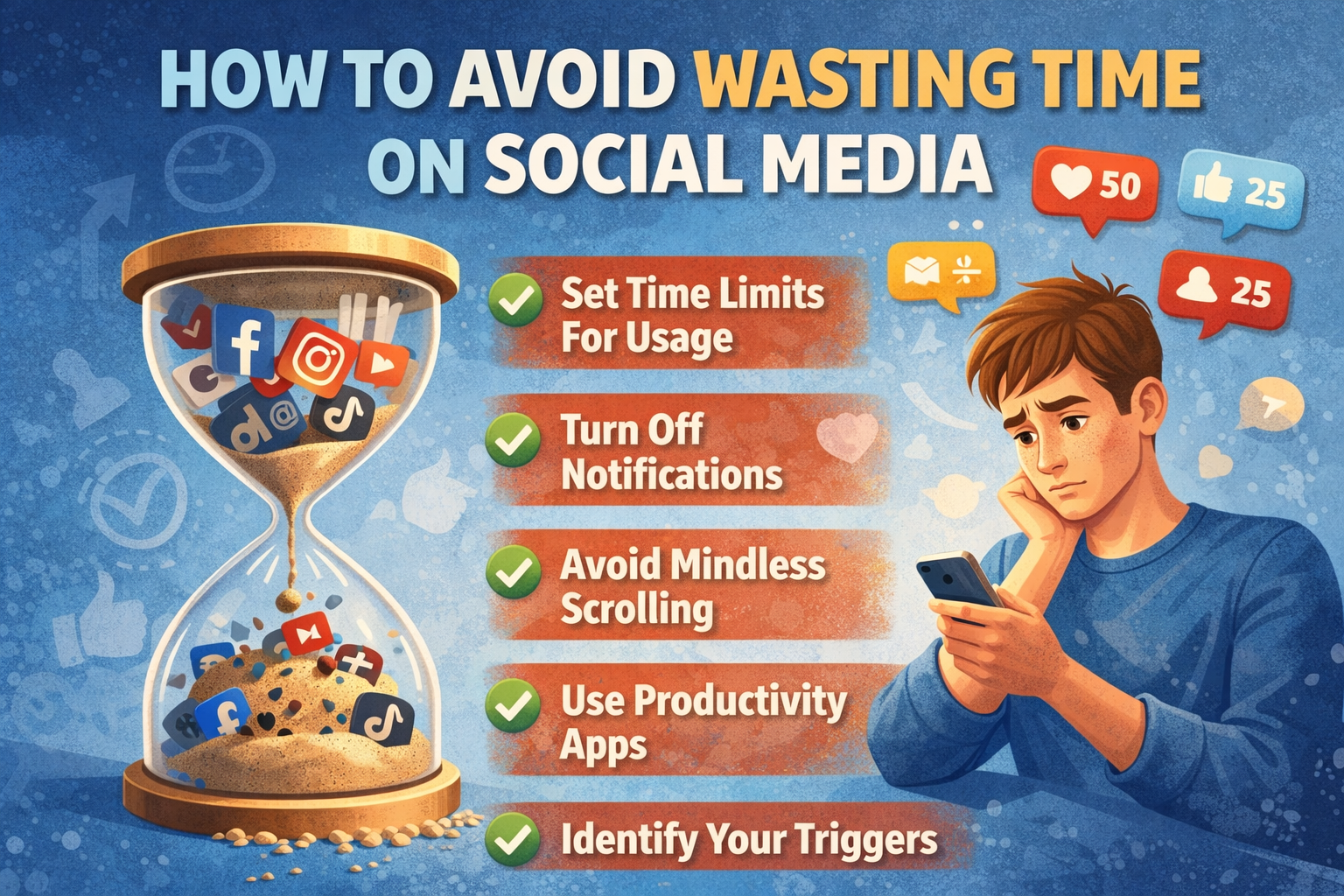
How to Avoid Wasting Time on Social Media
Social media is a big part of our daily life. We wake up and check notifications. We scroll during lunch breaks. Before sleeping, we spend “just five minutes” that often turn into one hour. Platforms like Facebook, Instagram, TikTok, and YouTube are designed to keep us engaged for as long as possible.
There is nothing wrong with using social media. It helps us stay connected, learn new things, and even grow our businesses. The real problem starts when we lose control of our time. Hours disappear, productivity drops, and we feel guilty at the end of the day.
If you often feel like social media is eating up your time, this guide will help you take back control.
Why Social Media Wastes So Much Time
Before fixing the problem, it’s important to understand why it happens.
Endless Scrolling
Most platforms use infinite scrolling. There is no natural stopping point. Your brain keeps thinking, “Just one more post.”
Dopamine Effect
Likes, comments, and notifications give small bursts of pleasure. Your brain wants more of that feeling, so you keep checking your phone.
Fear of Missing Out (FOMO)
You don’t want to miss important updates, trends, or news. This fear pushes you to check apps again and again.
Lack of Clear Purpose
Many people open social media without a reason. When you don’t have a goal, you get lost in random content.
Signs You Are Wasting Too Much Time
You might not even realize how much time you are spending. Here are some warning signs:
You check your phone first thing in the morning.
You feel anxious when you don’t have internet.
You open social media automatically when bored.
You delay important tasks to scroll.
You feel regret after long scrolling sessions.
If you relate to these signs, it’s time to make a change.
How to Avoid Wasting Time on Social Media
Now let’s talk about practical steps you can start today.
Set a Clear Purpose Before Opening Any App
Before opening social media, ask yourself:
Why am I opening this app?
What do I want to do?
How long will I stay?
For example:
Reply to messages (10 minutes)
Post content for business (15 minutes)
Check updates from close friends (5 minutes)
When you open the app with a purpose, you are less likely to scroll mindlessly.
Use Time Limits
Most smartphones have built-in screen time controls. Set daily limits for each app.
For example:
30 minutes for Instagram
20 minutes for Facebook
30 minutes for YouTube
When the limit is reached, stop using the app for the day. At first, it will feel difficult. But after a few weeks, it becomes normal.
Turn Off Unnecessary Notifications
Notifications are one of the biggest distractions.
Every time your phone vibrates, your focus breaks. Even if you don’t open the app, your mind shifts.
Go to your settings and turn off:
Like notifications
Comment alerts
Random suggestions
Live video alerts
Keep only important messages if needed. This small change can save hours every week.
Remove Social Media from Your Home Screen
If the app is visible on your home screen, you will open it without thinking.
Move social media apps to a folder or remove them from the main screen. Some people even uninstall apps and use them only on a browser.
When access becomes slightly harder, usage automatically decreases.
Create “No Phone” Time Blocks
Decide specific times when you will not touch your phone.
For example:
First hour after waking up
During meals
While working on important tasks
One hour before sleeping
These small rules create strong discipline over time.
Replace the Habit with Something Better
You cannot just remove social media. You need to replace it.
Instead of scrolling:
Read 10 pages of a book
Go for a short walk
Learn a new skill
Listen to a podcast
Write your goals
Your brain needs stimulation. Give it something useful instead of endless scrolling.
Use Social Media as a Tool, Not Entertainment
Ask yourself: Are you consuming or creating?
If you are a business owner, freelancer, or content creator, use social media with intention:
Post valuable content
Respond to clients
Learn industry trends
When you treat it as a tool for growth instead of entertainment, your mindset changes completely.
Track Your Screen Time Weekly
You cannot improve what you don’t measure.
Check your weekly screen time report. Write down:
Total hours spent
Most used app
Average daily usage
Set a goal to reduce usage by 10–20% each week until it reaches a healthy level.
Seeing numbers in front of you creates awareness and motivation.
Keep Your Phone Away While Working
If you are working or studying, keep your phone:
In another room
Inside a drawer
On silent mode
Even having the phone on the table reduces focus. Physical distance improves concentration.
Understand the Opportunity Cost
Every hour spent scrolling has a cost.
That one hour could be used to:
Learn a new skill
Exercise
Build a side income
Improve relationships
Rest properly
When you think in terms of opportunity cost, social media feels less attractive.
Do a Social Media Detox
If you feel completely addicted, try a short detox:
24-hour break
Weekend without social media
7-day challenge
The first day feels strange. By the third day, your mind becomes calmer. Many people realize they don’t miss it as much as they thought.
Focus on Long-Term Goals
People waste time when they don’t have clear goals.
Write down:
Where do I want to be in 1 year?
What skills do I need?
What habits must I build?
When your goals are clear, wasting time feels painful. Your priorities become stronger than your distractions.
Build Self-Discipline Slowly
Avoid extreme changes. Don’t say, “I will never use social media again.”
Instead:
Reduce 15 minutes daily
Avoid usage during work hours
Limit entertainment scrolling to weekends
Small consistent improvements work better than strict rules.
Social media is not the enemy. Lack of control is.
Platforms are designed to keep you scrolling. But you are stronger than an algorithm. When you use social media with purpose, set limits, and build better habits, you can enjoy its benefits without wasting your time.
Start small. Turn off notifications today. Set a time limit. Create one no-phone block.
Your time is your most valuable asset. Use it wisely.
FAQs
1. How many hours of social media per day is healthy?
There is no perfect number, but most experts suggest keeping it under 1–2 hours daily for personal use. The key is balance and purpose.
2. Why is it so hard to stop scrolling?
Social media platforms are designed to keep you engaged. Infinite scroll, notifications, and short videos trigger pleasure signals in the brain, making it hard to stop.
3. Should I delete social media completely?
Not necessarily. If it helps your business, networking, or learning, keep it. Just control how and when you use it.
4. How can I control social media during work hours?
Keep your phone away from your desk, use app blockers, and schedule specific times to check messages instead of checking randomly.
5. Can social media ever be productive?
Yes. It becomes productive when you use it with intention — for marketing, education, networking, or skill-building — instead of mindless scrolling.